Keto
Gluten-Free
30 Minutes
Game Day
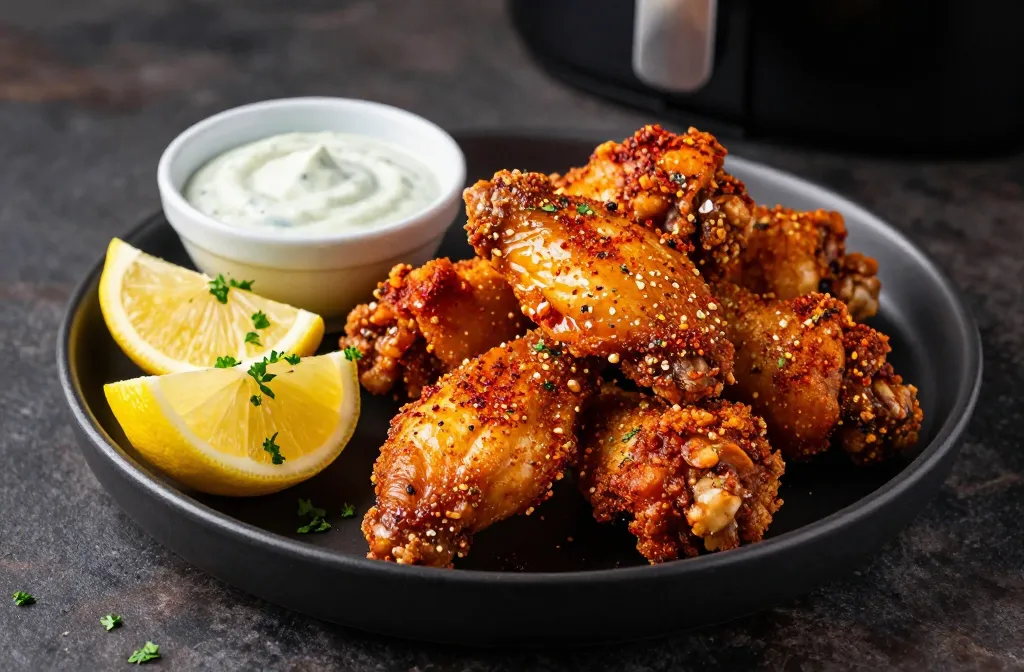
Crispy wings with a bold Cajun dry rub delivering heat, smoke, and savory depth—under 30 minutes, no breading, no sugar. A dry rub seasons the surface directly without adding moisture that would interfere with browning; baking powder raises skin pH and accelerates Maillard browning, producing crispness impossible to achieve with wet seasonings. Below: the exact Cajun spice blend, a timing guide by wing size, and the technique checklist that separates shatteringly crisp skin from yielding results.
Keto Air Fryer Chicken Wings Cajun Spiced
Ingredients
Method
- Pat the chicken wings completely dry with paper towels on all surfaces — surface moisture steams the skin instead of crisping it. Dry chicken browns better and accepts seasoning more readily.
- Rub the chicken lightly with 1.5 tablespoons of oil on all sides.
- In a small bowl, combine Cajun seasoning, garlic powder, smoked paprika, onion powder, and black pepper. Taste the blend—if it seems very salty, reduce additional salt or skip it entirely.
- Coat all sides of the chicken generously with the spice mixture. Press gently so it adheres. You should see a visible layer of seasoning.
- Rest the seasoned chicken at room temperature for 10 minutes. This allows the spices to hydrate and cling better.
- Preheat the air fryer to 380°F (193°C) for 3–5 minutes until screaming hot.
- Place the chicken in the basket in a single layer, not touching. Do not crowd or overlap.
- Air fry at 400°F for 18–22 minutes, flipping at the 10-minute mark to ensure even browning on all sides.
- Pull the chicken at 160–162°F internal temperature (measured in the thickest part). It will carryover to 165°F as it rests.
- Transfer to a plate and rest for 5 minutes. Do not skip this—resting redistributes juices and keeps the meat tender.
- Optional Top with 1 tablespoon melted butter and a squeeze of fresh lemon juice. Serve immediately.
Notes
Rest time Five minutes is non-negotiable. It allows muscle fibers to relax and reabsorb juices. Slice too soon and you'll cry juice onto your cutting board.
Cajun seasoning Store-bought blends vary wildly in salt content. Some are heavily salted, others are mild. Taste your blend before committing it to the chicken. Adjust salt accordingly.
Homemade Cajun blend 2 tsp paprika (smoked if possible), 1 tsp garlic powder, 1 tsp onion powder, 1 tsp dried oregano, 1 tsp dried thyme, 0.5–1 tsp cayenne (adjust for heat), 1 tsp black pepper, 0.5–1 tsp salt. Mix and store in an airtight jar for up to 3 months.
Oil matters A light coat helps browning and spices stick. Too much oil = steaming. Too little = seasoning slides off.
Preheat properly A hot basket sears better and crisps edges. Don't skip this 3–5 minute preheat.
Signs you nailed it Edges slightly crisp (not blackened), center juicy with clear juices, seasoning forms a flavorful crust that sticks.
Thighs alternative Boneless, skinless chicken thighs work beautifully. Cook at 380°F for 12–15 minutes, flipping halfway, until 175°F internal. Thighs forgive slight overcooking and stay juicy longer.
Storage Cool completely, refrigerate in airtight container up to 4 days. Reheat gently in the air fryer at 350°F for 3–4 minutes, or slice and warm in a skillet with butter.
Overcooked chicken rescue Slice thin, toss with melted butter and lemon, and serve with a creamy dip (aioli, ranch, or chipotle mayo). Texture + fat = redemption.
Why This Recipe Works
Every component addresses a specific mechanism of browning, fat rendering, or flavor delivery.
The Cajun spice blend delivers savory, aromatic heat without liquid. A proper Cajun profile combines paprika (for color and mild pepper notes), garlic and onion powder (for umami depth), oregano and thyme (for herbal complexity), and cayenne (for heat). Because this is a dry rub, it seasons the wing surface directly without adding moisture that would delay or prevent browning. Paprika contains capsaicin, which provides gentle heat; oregano and thyme add herbal notes that pair well with smoke and pepper. Together, they create a complex, savory profile that develops intensity during cooking.
Smoked paprika adds depth without additional carbs. Smoked paprika is paprika that has been dried over smoke, concentrating flavor and adding a subtle smoky undertone. This single ingredient contributes both color and flavor complexity that would otherwise require added liquids or sauces. Smoked paprika brings the perception of slow-cooked, deeply flavored food without the time or carb additions.
Baking powder raises skin pH and accelerates Maillard browning. Maillard browning—the reaction between amino acids and reducing sugars that produces brown color and savory flavor—occurs at lower temperatures in alkaline environments. Baking powder is sodium bicarbonate, which is alkaline. Dusting wings with aluminum-free baking powder raises the pH of the skin surface, lowering the temperature threshold for Maillard reaction initiation. This causes browning to begin sooner and progress more aggressively in a given cook time. Additionally, the alkaline environment slightly denatures skin proteins, causing them to release surface moisture more readily during cooking. One teaspoon across 2 lbs of wings produces measurable improvement in color, crispness, and overall texture.
High-temperature air frying renders fat while crisping the exterior. Chicken wings carry skin and subcutaneous fat. Air fryer convection forces hot air at high velocity across the wing surface. This heat causes subcutaneous fat to render (liquefy), flowing downward through the skin. As this fat layer thins, the exterior skin surface has less insulation between itself and the circulating hot air, allowing more aggressive surface browning. Unlike deep frying, which submerges wings in oil and produces greasiness, air frying achieves this fat rendering with minimal added oil—producing a crispy exterior that is not laden with absorbed oil.
A preheated basket initiates browning immediately. Placing cold, damp wings into a cold basket means the surface temperature rises slowly. During this period, residual surface moisture evaporates as steam. Steam prevents crust formation because it blocks surface temperatures from climbing past the Maillard threshold. A 3–5 minute preheat ensures that the moment wings enter the basket, the surface temperature crosses the browning threshold, beginning the Maillard reaction before moisture escapes as steam.
Flipping halfway distributes heat and promotes even browning. The air fryer’s heating element and fan create airflow patterns. Depending on basket design, the strongest airflow may be at the rear, nearest the fan. Flipping at the midpoint allows wings that began in cooler positions to rotate into stronger airflow zones, promoting more even browning across the batch.
The 185–190°F internal target produces juicy wings. Poultry is safely cooked at 165°F. Chicken wings, which carry significant intramuscular fat, benefit from higher temperatures. Above 175°F, collagen (the primary structural protein in connective tissue) begins converting to gelatin. At 185–190°F, this conversion is complete, producing meat that is noticeably more yielding and juicy. Because of the fat content, wings do not dry out at these higher temperatures the way lean breast meat would.
Timing Guide by Wing Type and Load
| Wing Type | Quantity | Basket Arrangement | Total Time | Flip At | Notes |
|---|---|---|---|---|---|
| Mixed party wings (flats + drumettes) | 2 lbs | Single layer, no overlap | 18–22 min | 9–11 min | Cook similar-sized pieces together for even doneness |
| Flats only | 2 lbs | Single layer, no overlap | 16–18 min | 8–9 min | Flat, thin pieces cook faster |
| Drumettes only | 2 lbs | Single layer, no overlap | 20–22 min | 10–11 min | Thicker, meatier pieces require longer |
| Second batch (in progress) | 2 lbs | Single layer, no overlap | 18–22 min | 9–11 min | Keep first batch warm at 200°F on wire rack |
Always verify with a thermometer: 185–190°F in the thickest part of a drumette or flat is the target. Timing varies by air fryer wattage and internal volume. Treat the above as calibration guide for your first cook.
The Key Technique Checklist
In order of impact. The first two steps determine the majority of the result.
1. Pat wings completely dry with paper towels.
Use multiple sheets and be thorough. Moisture = steam = soggy skin. Go over all surfaces multiple times, pressing firmly, until no visible moisture remains. This is the foundation of crispness.
Why: Moisture must evaporate before the skin surface temperature can climb above 150°C (300°F). Thorough drying removes this barrier to browning.
2. Preheat the basket at 390–400°F for 3–5 minutes before loading.
A cold basket means the first few minutes of cooking are spent heating the surface rather than browning the wings. This step is consistently skipped and accounts for most pale, soggy results. Five minutes is a small investment for measurably better texture.
Why: A preheated basket ensures browning begins immediately upon contact, before surface moisture can escape as steam.
3. Coat evenly with the Cajun rub and oil.
Toss wings thoroughly so every surface—undersides included—receives an even coating. Uneven seasoning produces uneven flavor and visual appearance.
Why: A dry rub’s effectiveness depends on even distribution. Bare patches will be underseasoned.
4. Rest for 5–10 minutes after seasoning and before cooking.
This optional step allows salt to begin penetrating the surface and flavors to develop slightly. It is not essential, but it improves the final result.
Why: Surface salt penetration improves seasoning depth and supports browning.
5. Arrange in a single layer with at least 0.5 inches of space between pieces.
Overlapping or touching wings trap steam in contact zones, producing soggy spots that never crisp. If your basket cannot accommodate all wings with proper spacing, cook in batches. Keep the first batch warm in a 200°F oven on a wire rack.
Why: Airflow equals crispness. Blocked airflow = blocked browning.
6. Do not open the basket during the first 10 minutes.
Opening drops internal temperature and interrupts fat rendering, producing uneven browning. Set a timer and commit to the first phase.
Why: Early heat loss disrupts fat rendering, producing inconsistent texture.
7. Flip at the designated time and finish for the second phase.
The second half of cooking directs convected air onto the other side of the wings. Flipping also rotates wings so those in cooler positions move into warmer zones.
Why: Wings have two flat surfaces. Both require direct heat exposure for even browning.
8. Pull at 185–190°F, not 165°F.
This is 20–25°F above the poultry safety threshold. At this temperature, collagen is fully converted to gelatin, producing noticeably juicier wings. Wings do not dry out at this temperature because of their fat content.
Why: Temperature determines collagen denaturation. Above 175°F, collagen becomes gelatin.
The first time I tested this Cajun blend without baking powder, the color was pale and the skin remained yielding rather than shatteringly crisp. Adding baking powder changed both visibly—deeper browning and a more aggressive crunch that persists into the second day of storage. Cayenne alone does not produce sufficient browning; baking powder is essential for the texture this recipe promises.
Seasoning Profiles — Same Method, Different Heat or Finish
The Cajun rub is the foundation. These variations adjust heat level or add finishing components without changing cook method.
Cajun Light (Lower Heat)
Reduce cayenne to 0.1 tsp or omit entirely. The remaining spices—smoked paprika, garlic, oregano, and thyme—deliver flavor complexity without significant heat. Paprika provides mild pepper notes; oregano and thyme provide herbal depth.
0g Net Carbs
Best for: Heat-sensitive diners, mixed-audience gatherings
Cajun Bold (Higher Heat)
Increase cayenne to 0.5–0.75 tsp. This amplifies the Cajun profile to a more pronounced, peppery heat. Serve with cool ranch or blue cheese dressing to balance the intensity.
0g Net Carbs
Best for: Heat-loving diners, bold-flavor preferences
Cajun + Lemon Finish
Cook wings with the base Cajun rub. After cooking, squeeze fresh lemon over hot wings. The citric acid brightens the savory, herbal Cajun profile and cuts through rendered fat.
0g Net Carbs
Best for: Fresh, summery service variation
Cajun + Butter Finish
Cook wings with the base Cajun rub. While still hot, toss in a mixture of 2 tbsp melted butter and a pinch of additional Cajun rub. The butter carries the spices onto the surface and adds richness.
~1g Net Carbs
Best for: Higher fat macro days, richer flavor preference
What to Serve With This
Cajun’s bold, spicy profile pairs best with cool, tangy, or textural sides that provide contrast.
- Celery and cucumber sticks with ranch dressing: The cool crunch and creamy tang balance Cajun heat. These are the traditional pairing for a reason.
- Keto coleslaw with tangy vinaigrette: Shredded cabbage, vinegar, and minimal dressing provide acidity and textural contrast. The vinegar cuts through rendered fat.
- Simple green salad with lemon-oil dressing: Arugula or mixed greens with lemon juice, olive oil, and salt provide fresh, bright contrast to Cajun’s spice and heat.
- Blue cheese dressing or ranch: Creamy, cool dips balance spicy, hot wings perfectly.
Keto macro note: 6–7 wings (approximately 8–10 oz cooked, 0g net carbs) paired with 2 cups of celery and cucumber sticks (approximately 6g net carbs) and 3 tbsp of ranch dressing (approximately 1g net carbs) totals approximately 550 calories, 38g protein, 38g fat, and 7g net carbs—a complete, satisfying meal within standard keto targets.
Meal Prep and Storage
Cool completely before storing. Trapping heat inside a closed container allows steam to condense on the wings, softening the crispy skin. Always cool on a wire rack before sealing.
Refrigerate cooked wings for up to 4 days in an airtight container. The skin will soften slightly as it sits, but the meat remains tender and flavorful cold or at room temperature.
Reheat at 375°F in the air fryer for 4–6 minutes to restore crispness. The air fryer re-crisps the skin in a way that an oven or microwave cannot replicate. Do not use a microwave unless absolutely unavoidable—microwave reheating produces rubbery, limp skin.
Freeze cooked wings in a single layer for up to 2 months. Thaw in the refrigerator and re-crisp at 375°F for 6–8 minutes.
Batch cook and keep warm: If making multiple batches, keep finished wings in a 250°F oven on a wire rack while cooking subsequent batches. Before serving, give everything a final 2–3 minute blast at 400°F to ensure uniform crispness across all batches.
Troubleshooting
FAQ
Yes, but thaw first for best texture and seasoning adhesion. If you must cook from frozen, add 5–8 minutes to total cook time. Frozen wings release significant moisture during the thaw phase, which interferes with browning.
Not technically, but it produces measurably better results. If you skip it, ensure you dry the wings obsessively and extend the cook time by 2–3 minutes. The improvement from baking powder is visible and worth the addition.
Mild to medium. Cajun heat comes from 0.25–0.5 tsp cayenne across 2 lbs of wings—a gentle pepper flavor rather than a fiery burn. If you prefer less heat, reduce cayenne to a pinch; for more heat, increase to 0.75 tsp.
Avocado oil (smoke point ~520°F / 270°C) handles high heat without off-flavors. Light or refined olive oil (smoke point ~240°C) is acceptable. Extra virgin olive oil (smoke point 160–190°C) is not suitable at these temperatures.
Only if you want extra insurance. The rub contains enough oil to prevent sticking on most nonstick baskets. If you choose to spray, use a pump spray bottle with avocado oil. Avoid aerosol sprays—propellants degrade nonstick coatings at high heat.
Yes. Use a wire rack over a sheet pan at 425°F (220°C). Bake 20 minutes, flip, then bake 20–25 minutes more until crispy. Finish with 3–5 minutes under the broiler for extra crunch. Air frying is faster and produces superior texture, but baking is a viable alternative.
Yes. Mix the dry spices in bulk (paprika, garlic, onion, oregano, thyme, salt, pepper, cayenne—omit baking powder). Store in an airtight jar for up to 6 months. Add baking powder only when ready to season wings. Baking powder can lose potency over time.
Air fryer wattage and design vary. Some run 15–20°F above their display temperature. Invest in a reliable instant-read meat thermometer and target 185–190°F internally. Treat the recipe timing as a starting reference to adjust from on your first cook.
Your Next Recipe
Crispy Air Fryer Keto Chicken Wings — Old Bay Seasoning—the same baking powder and air fryer technique applied to wings with a different seasoning profile. If you mastered the drying and preheating here, the Old Bay variation transfers directly; only the spice blend and optional finishing sauce change.
Cajun seasoning is often perceived as requiring slow cooking to develop flavor—a misconception built on the tradition of Cajun braise and stew cooking. In reality, the aromatic spices in a proper Cajun blend (paprika, oregano, thyme) release volatile flavor compounds when dry-heated, making them ideal for high-temperature applications like air frying. The heat and velocity of air frying actually intensify the perception of Cajun flavor compared to slow moist cooking, where those volatile compounds are trapped as steam and never fully express.
Did you adjust the cayenne from the base recipe? If so, what level of heat did you land on, and did it work for your audience?
More Keto Air Fryer Chicken Recipes
→ Crispy Air Fryer Keto Chicken Thighs — Bone-In, Skin-On
→ Extra Crispy Skin-On Air Fryer Chicken Thighs
→ Crispy Air Fryer Keto Chicken Wings — Old Bay Seasoning
→ Air Fryer Keto Chicken Breast
→ Pork Rind–Crusted Air Fryer Fried Chicken
→ Keto Chicken Meal Prep — 4 Flavours, 1 Hour
→ Almond Flour–Crusted Keto Chicken Tenders
→ Air Fryer Keto Chicken Shawarma
→ View All Keto Air Fryer Recipes
Printable Recipe Card
Want just the essential recipe details without scrolling through the article? Get our printable recipe card with just the ingredients and instructions.